Showing posts with label southeast asian food. Show all posts

Saturday, July 18, 2020

Variations on Filipino Adobo: Spice Paste


I keep imagining what Filipino food would be like if the Spanish influence was scaled down to a minimum. I keep looking at Indonesian cuisine and Malaysian cuisine; all three countries have a shared history and culture. Perhaps that kind of Filipino food already exists in the southern islands, but there is another factor that I would like to add in: being a Filipino in California. What happens to Filipino food if the use of spice pastes became more common, just like in Indonesia and Malaysia? What does California- Malay-amplified- Filipino diasporic cuisine look like? What if the Fujian influence was amplified? What if the South Indian influence was amplified?

**edit: As with all adobos, I suggest not eating this on the same day. Adobo tastes better the following day. My theory is that the vinegar mellows out and the meat marinates even longer.

Ingredients:
  • chicken legs and thighs, attached, skin on, bone in, 3 each (total of 3 thighs and three legs)
  • soy sauce, 1/2 cup
  • cane vinegar, 3/4 cup
  • water, 2 cups
  • coconut milk, 1 can
  • garlic cloves, 10 each
  • shallots, slice into large chunks, 4 large
  • fresh turmeric, sliced unpeeled, 2-inch piece
  • cilantro stems, roughly chopped, 2 tablespoons
  • limes, 2 each
  • ground coriander, 1 teaspoon
  • bay leaves, 5 each
  • whole black peppercorns, 2 tablespoons
  • tomato paste, 2 tablespoons
  • kale, ribbed, cut into 1-inch pieces, 1/2 bunch
  • brown sugar, 2 tablespoons
  • sea salt, to taste
  • grapeseed or any neutral oil, 2 tablespoons
Season chicken with salt. Set aside.
Make a spice paste with garlic cloves, shallots, fresh turmeric, cilantro stems, 3 strips of lime zest, and ground coriander using a food processor or an immersion blender. Set aside.
Heat grapeseed oil over high heat in a heavy bottomed pot. Sear chicken legs and thighs on both sides until skin is golden brown. Lower heat, remove chicken from the pot and set aside.
Slowly and carefully add in the spice paste and gradually increase the heat to medium. Cook the spice paste until fragrant and darkens in color. Add the tomato paste and cook until the mixture starts to coat the bottom of the pot.
Add the chicken back into the pot along with the bay leaves and peppercorns. Pour in the soy sauce, vinegar and water. Increase heat to high and bring to a boil. Cover and lower heat and simmer for 40 minutes.
After 40 minutes, uncover, and increase heat to medium high, and simmer for 15 more minutes.
Pour in coconut milk and mix in brown sugar. Simmer for 15 more minutes or until the sauce thickens to a consistency of heavy cream.
Turn off heat and add in kale. Let the residual heat of the curry wilt the greens. Adjust seasoning and add in lime juice. Garnish with cilantro leaves. Eat with jasmine rice.

Sunday, July 5, 2020

Variations on Filipino Adobo: Coconut Milk


I am currently in a deep dive into the Philippines' pre-colonial history. I have so many thoughts and feelings that haven't solidified. It might take a while to put them into words. One thing that I now completely understand is that cultures do not exist in isolation.

Before the Philippine Islands were unified under Spanish control, it consisted of separate Austronesian sovereign states heavily influenced by empires all over Asia via the Maritime Silk Road: the Song and Yuan Dynasties influenced the north (Pangasinan was a tributary state where the Yongle Emperor became an honorary leader), the Sultanate of Brunei, the Majapahit and Srivijaya Empires (which the Visayas region is named after), and the Chola Empire of South India (a minor prince from the empire saw opportunity to establish his own Rajahnate in the island now called Cebu, effectively including the region in the Indosphere). Pre-colonial Filipinos welcomed Islam, Buddhist, and Hindu influences.

I am beginning to understand why Filipino cuisine is difficult to define because it has so many layers of history and influences. It explains why we have dishes similar to curries of other South and Southeast Asian regions. Today I made pork adobo with coconut milk. The use of coconut milk is probably a direct influence of the Chola Empire of South India where the use of coconuts are ubiquitous. In the Philippines, the use of coconut milk is typically found in the Visayas and Mindanao regions, where this variation was probably born. I added kale in the recipe. It is completely optional. I just needed to eat some greens.

Ingredients:
  • pork roast shoulder, excess fat trimmed, cut into 1-inch cubes, 3 lbs.
  • soy sauce, 1/2 cup
  • cane vinegar, 3/4 cup
  • water, 1/2 cup
  • coconut milk, unsweetened, 1/2 can
  • garlic cloves, crushed, 10 each
  • red onion, small dice, 1 large
  • green onions, sliced, white parts separated from green, 3 stalks
  • Anaheim chili, split in half lengthwise, seeded and cut into thirds, 1 each
  • bay leaves, 5 each
  • whole black peppercorns, 2 tablespoons
  • brown sugar, 2 tablespoons
  • sea salt, to taste
  • grapeseed oil, 2 tablespoons
Season the pork with salt. Allow it to sit at room temperature while you prepare the vegetables, but no more than 45 minutes.
Heat oil on high flame in a heavy bottomed pot. Sear pork on two sides until brown but not completely cooked. You want to develop a fond at the bottom of the pot. Take pork off the pot and set aside.
Add onions, white part of the green onion, and garlic cloves in the pot and saute until fragrant and onion is translucent. Make sure to scrape the fond at the bottom of the pot at this stage.
Add the bay leaves, and whole peppercorns in the pot along with the seared pork.
Pour in the vinegar, soy sauce, and water. Bring to a boil, cover, lower heat to medium, and simmer for 45 minutes.
Uncover and pour in coconut milk and then add the chili. Bring back to a boil, and then lower heat to medium and simmer until pork is tender, around 30 minutes. During simmering add in the brown sugar.
Turn off heat then stir in green part of green onion. Eat with jasmine rice.

Saturday, June 27, 2020

Variations on Filipino Adobo: Mushrooms


This is a recipe that I will have to develop further. I sort of knew that mushrooms won't really work as the main ingredient of adobo, but I went ahead and tried anyway. Firstly, I am not a fan of the texture of stewed mushrooms, but this could be from the types of mushrooms I used - king trumpet, maitake, and buna-shimeji mushrooms. Secondly, since this is a vegan recipe and is a relatively quick cook, it lacks the flavor development that happens when something is stewed for a long time. Thirdly, I only used about a tablespoon of brown sugar for sweetness, but I think it needs another form of sweetness - perhaps from oyster sauce (but it wouln't make the dish vegan anymore). I personally cannot eat a lot of it, but the dish is good with jasmine rice. I can see the recipe being modified further for steamed buns if I add crumbled tofu, scallions, honey, and sesame oil. Or maybe even as empanada filling. For now, I'm gonna have to mix these mushrooms with other quick stir fry dishes. Here's the recipe if you want to try it: (Feel free to cut the recipe in half.)
  • maitake mushrooms, broken into large segments, 2 packages
  • buna-shimeji mushrooms, broken into large segments, 2 packages
  • king trumpet mushrooms, cut into thirds and torn into large chunks, 1 package
  • shallots, large, minced, 2 each
  • ginger, 1-inch knob, minced
  • garlic cloves, minced, 6 each
  • soy sauce, 1/4 cup
  • water, 1/4 cup
  • unseasoned rice vinegar, 1/4 cup
  • white miso, 1 tablespoon
  • bay leaves, 2 each
  • whole black peppercorns, cracked, 1 tablespoon
  • grapeseed oil, as needed
  • chives, minced, to taste
  • parsley, minced, to taste
In a small bowl, whisk soy sauce, rice vinegar and white miso until cohesive. Set aside.
In a wok or a sautoir, heat oil over high heat. Saute maitake mushrooms until at least one side has browned. Remove from the pan and set aside. Do the same for the rest of the mushrooms in batches. King trumpet mushroom will take the longest to brown as they release a lot of water.
Add a little more oil in the pan and saute shallots, ginger, and garlic until fragrant and shallots are translucent.
Pour in the sauce mixture and add bay leaves and peppercorns. Simmer for a minute and then add the mushrooms back in along with the 1/4 cup water. Simmer until the sauce reduces into gravy consistency, around 10 minutes. Lower the heat and mix in brown sugar. Taste and add more sugar if you like. Turn off heat and mix in parsley and chives.


Friday, June 19, 2020

Variations on Filipino Adobo: Tomato


This week was tough. I watched so many YouTube videos and read so many recipes about adobo. I also read through Reynaldo Alejandro's The Philippine Cookbook from 1983. It was probably one of the first Filipino cookbooks catered to the American kitchen, and it was disappointing. It isn't surprising though, since it was published in 1983. While reading, I started to become aware of this large hole in Philippine history. When I was a young student in Manila, Philippine history was taught starting from Spanish colonization. There was maybe a day dedicated to prehistory, but nothing in between that time and the Spanish era was taught. On top of that we were taught to be grateful for all the "innovations" that the Spaniards brought, mainly Catholicism. The Philippine Cookbook has the same underlying tone. 

Adobo was named by the Spaniards even though the dish existed even before the Spaniards came. They just didn't know what to call it. That is what exactly got me deeply emotional. The Spaniards changed our lingua franca, changed our names, and erased our history.

I was uprooted from my home country at a very young age, but being in a different country made me feel a lot more Filipino. I was craving my history. I have no knowledge of what the Philippines was before the Spaniards came, but there is so much power in being able to define and decide what it means to be a part of the Filipino diaspora in the now and in the future. I choose to define it through food.

Many might say that this recipe is not adobo. But I will argue that it is cooked in the style of adobo: meat stewed in soy sauce and vinegar with bay leaves, garlic, and peppercorn. I changed the ratio of vinegar and soy sauce to equal parts and used fresh tomatoes and tomato paste to compensate for acidity. This would be really good with buttery mashed potatoes. It's also important to know that this was a stove-top braise but it can definitely be done in the oven. However, the sauce will still need reducing on the stove-top.

Ingredients:
  • beef short ribs, bone in, 3 lbs.
  • soy sauce, 1/2 cup
  • balsamic vinegar, 1/2 cup
  • water, 1 cup + 1/4 cup
  • garlic cloves, crushed, 6 each
  • large shallots, sliced, 4 each
  • whole black peppercorn, 2 tablespoons
  • bay leaves, 5 each
  • large vine-ripened tomatoes, chopped, 2 each
  • double concentrated tomato paste, 2 tablespoons
  • chives, minced, to taste
  • sea salt, to taste
  • grapeseed oil, 2 tablespoons
  • (optional) calamansi citrus or lemon juice, to taste
Season ribs with salt. Over high flame, heat oil in a large heavy bottomed pot. Sear ribs, fat side down until rendered and golden brown. Lower heat, remove ribs from pot and set aside.
Turn heat to medium and add in shallots and garlic. Saute until shallots are translucent. and in tomato paste and cook until the paste darkens in color and oil begins to separate. Add in fresh tomatoes and let its juices deglaze the bottom of the pot.
Add the ribs back into the pot along with bay leaves and black peppercorn. Pour in soy sauce, balsamic vinegar and water. Bring to a boil.
Once it boils, bring back down to simmer and cover. Simmer for 2 hours or until ribs are tender. Check after 1 hour to see if water needs to be added.
After 2 hours, uncover and turn heat to medium and reduce the sauce by half. Season with salt to taste.
Squeeze calamansi citrus over the dish. Sprinkle with chives.

Saturday, June 13, 2020

Variations on Filipino Adobo: Thyme and Grapes


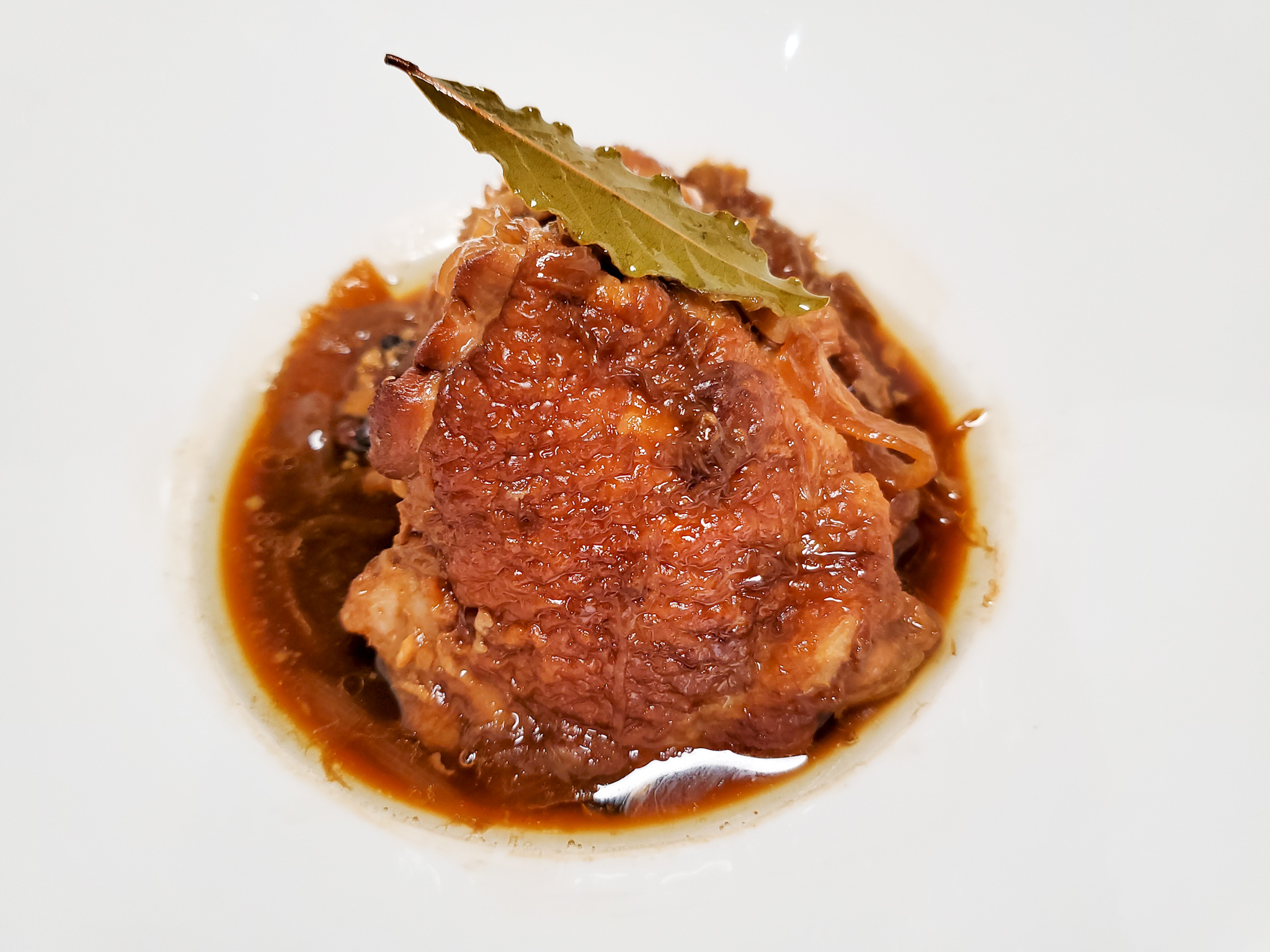
The classic adobo is perfect in its simplicity. It gets its depth of flavor from braising bone-in chicken thighs and legs, highlighted by the savory aromas of bay leaves and black peppercorns. The sauce is perfectly loose, designed to be soaked up by jasmine rice. It is sour-forward with the saltiness of soy sauce coming in close second.

I don't like the idea that the variations of this dish are improvements. I don't think this dish needs to be elevated, although some may think of it as such. In this variation I was thinking about sweetness, aroma, and body. Some adobo recipes call for sugar to blunt the sharpness of vinegar. But I like the idea of fruit as a sweetener. In a previous post, I made an adobo with eggplant sweetened by an Asian pear, inspired by Korean cuisine. Since it's in season, I decided to use grapes and grape jelly. And keeping in line with fruitiness, I used apple cider vinegar instead of cane vinegar. The jelly gives body to the sauce while the fruit provides freshness to an otherwise heavy sauce. The butter lightens the sauce but it also softens the vinegar. I also thought that thyme is the perfect herb to compliment the savory soy sauce. The shallots are milder in flavor but it has a sweeter onion smell. The result is a type of adobo that can go well with buttered egg noodles or pasta, or even with a baguette.

Anyway, here's how to fuck it up:
  • chicken legs, thighs or both, bone-in, skin on 4-6 pieces depending on size
  • soy sauce, 1/2 cup
  • apple cider vinegar, 3/4 cup
  • water, 1/2 cup
  • garlic cloves, crushed, 6 each
  • shallots, slices, 4 large
  • thyme, 1 sprig
  • grapes, halved, 10-15 each
  • black peppercorn, 2 tablespoons
  • bay leaves, 5 pieces
  • grape jelly, 2 tablespoons
  • unsalted butter, 1 tablespoon
  • olive oil, 1 tablespoon
  • sea salt, to taste
In a bowl, combine chicken, soy sauce, vinegar, and garlic. Marinate for 30 minutes.
Once chicken is done marinating, take the chicken out of the liquid and pat dry. Reserve marinating liquid.
Heat oil in sautoir over high heat. Sear chicken skin side down. Remove from pan once browned.
Drain some fat from the pan, leaving about a tablespoon. Turn heat down to medium and add shallots. Saute shallots until translucent.
Add chicken back in the pan and pour in the marinating liquid and water. Make sure to scrape the bottom of the pan. Add thyme, black peppercorn, and bay leaves and bring to a boil.
Turn heat down to medium low, cover and simmer for 30 minutes.
Uncover and reduce liquid by half. Turn heat to low and melt grape jelly into the sauce, Season with sea salt to taste (it might not need it). Turn off heat and swirl in butter.
On a separate saute pan, fry grapes in olive oil until heated through. Garnish on top of the dish.

Wednesday, June 10, 2020

A Return to the Food World with Adobo


Art making is over for me. It's been over since I started working in museums, to be quite honest. I decided I'm going to pivot back into studying cuisine, and divert a huge portion of my energy back into recipe developing. When Bon Appetit Magazine's Adam Rapoport resigned from his position as editor-in-chief, I was given hope again. White Supremacy tells Black and Brown people that they are inadequate in ways that are both subtle and overt. I have internalized this for such a long time. I lost courage when I was working two full-time restaurant jobs a decade ago, one in  a Michelin-starred restaurant and another in a restaurant in Culver City that doesn't exist anymore. It was wild to think that I was simultaneously working for the best kitchen in town and the worst kitchen in town. I was buried in student loan debt (I still am), and so many of my White counterparts were being offered sous chef and chef de cuisine positions while I worked for a shitty line cook from Robuchon who somehow ended up being the chef of Fraiche in Culver city. As you can see in the previous posts, I tried my hands at food blogging three years ago and hit a lot of walls. Simmering deep within me is the frustration from the fact that White men have such a monopoly on cuisine and food writing. When so many BIPOC food writers and chefs made their voices heard about Rapoport's unacceptable actions, my flame was reignited. It's terrible that it took this long and within the protests about police brutality. Yet, it was so inspiring to see everyone speak up. I'm going to add my voice back into the pot, this time with a lot more confidence and conviction.

I was all fired up. I felt so restless last night that I cooked. I began with what I know really well, and it is something that I've eaten my entire life: the Adobo. I won't be going into its history that much as there are probably a lot of articles about it. What I do want to emphasize is that there is no standard recipe for this dish. Each Filipino household have their own way of preparing it. There are plenty of regional variations. And the dish evolves in whichever country it was taken to via immigration.

I made the "classic" adobo. Classic because it's the variation I grew up eating, and it is the variation that most Filipinos are familiar with: soy sauce- and vinegar-based. The project that I've given myself is to cook as many variations using the "classic" recipe as the starting point -- tapping a little bit into regionality, but more focused on new combinations of ingredients based on season and availability.

Really, I think this is a meditation on the adaptive qualities of a culture's recipes, which in turn reflects the resilience of its people. I haven't been this excited about a project in a while. I can't wait to share what I discover with everyone.

Anyway, here's how to fuck it up:
  • bone-in, skin on chicken thighs, 4-6 pieces depending on size
  • Filipino soy sauce (Silver Swan or Datu Puti), 1/2 cup
  • cane vinegar, 3/4 cup
  • water, 1/2 cup
  • garlic cloves, crushed, 6 each
  • yellow onion, sliced, 1/2 of large or 1 medium
  • whole black peppercorns, 2 tablespoons
  • bay leaves, 5 leaves
  • neutral cooking oil, 1 tablespoon
  • sea salt, to taste
In a large bowl, combine soy sauce, vinegar and garlic together. Add the chicken to the mixture and marinade for 30 minutes.
Once chicken is marinated, remove from the liquid and pat skin dry. Set marinating liquid aside.
Heat oil in a sautoir pan over high heat. Sear the chicken, skin side down, taking care to not overcrowd the pan. Do not move or rotate chicken until the skin is browned.
Once skin is brown, lower the heat and remove the chicken from the pan. Set aside. Drain excess fat from the pan leaving about a couple of tablespoons behind. Add onions and turn heat back up to medium. Saute onions until they are translucent. Make sure to scrape the brown bits that are stuck at the bottom of the pan.
Pour in the marinating liquid and water. Add back the chicken, and then add the black peppercorns and bay leaves. Turn heat to high and bring to a boil then cover and lower heat to medium low. Simmer for 30 minutes.
Uncover then reduce liquid by half, about 30 minutes. Season with salt.

Wednesday, November 23, 2016

Fried Rice / Nasi Goreng


Grocery shopping and cooking for one is hard and I'm realizing that it can be as expensive as eating out (which I have been doing a lot) because of the amount of waste that it produces. Greens and fresh herbs don't last long enough to be used for the next dish (or only very little survive). It's really tricky if you have a busy schedule. I bought a whole bunch of groceries that are just sitting in the fridge for a couple of weeks now. My bank account was thinning and I still had leftover rempah from when I made laksa almost a month ago. I was surprised that the rempah was still good, so I made the same laksa broth and just added Thai eggplants that I bought a couple of weeks ago thinking I have time to make jungle curry. I also added grated coconut which I also bought a couple of weeks ago thinking I have time to make rendang. I ate it with jasmine rice for lunch and I didn't really like it...partly because I had to wait a few hours to eat it and the rice just absorbed all the sauce, but also the sauce is just not good with rice.

I had some leftover shrimp in the freezer and bought a whole sword squid from Mitsuwa a couple of days ago. I have a bunch of green onions wilting away in the fridge. So I decided to make fried rice, Indonesian-style before everything goes to waste. That being said, I don't mean to reduce fried rice as a leftovers dish because it's definitely an elegant dish. It's also a very comforting dish. I would eat garlic fried rice (called sinangag in Tagalog) with fried egg almost every morning even to this day. There's also plenty of family dinners where we would eat Chinese-style fried rice and fried squid, Chinese-style pork chops, roast chicken, etc... And I love kimchi bokkeumbap!

I learned Indonesian fried rice (nasi goreng) in culinary school and the most important ingredient in this dish is kecap manis. This sweet, syrupy dark soy sauce is ubiquitous in Indonesian kitchens. If you can't find this ingredient, do not substitute regular soy sauce, just omit it from the recipe.

12 pieces tiger shrimp, peeled and de-veined
1 whole squid, cut into batons
5 cups cooked jasmine rice, preferably a day old
1 large shallot, sliced thin
5 cloves garlic, minced
1 tbsp shrimp paste
1/4 cup kecap manis
1/4 cup green onions, sliced into rings
2 eggs, beaten
cilantro, roughly chopped
fish sauce, to taste
coconut oil

optional toppings:
sliced cucumber, sliced tomatoes, limes, shrimp chips

Heat coconut oil on high in a large saute pan or wok. Cook shrimp until it starts to turn pink, remove from the pan and set aside. Add in squid and cook until semi-translucent, about 30 seconds, remove from the pan and set aside. Saute garlic, shallots, and shrimp paste until garlic starts to caramelize. Add in rice and stir continuously until grains separate. Drizzle in the sweet soy sauce, then stir fry until rice is coated with the sauce. Push rice to the side of the pan to make room. Drizzle a little oil in the empty area and pour in the eggs, stir until it starts to solidify then slow stir in the rice into it. Keep stir frying until moisture evaporates and rice is relatively dry (a little bit of toasted crunchiness at the bottom of the pan is highly recommended). Add back in the shrimp and squid, then add in the green onions. Drizzle fish sauce to taste and stir fry until shrimp is completely cooked. Sprinkle cilantro and mix. Serve with cucumber slices, tomatoes, lime wedge and shrimp chips on the side.

Wednesday, November 16, 2016

Jackfruit, Mechado-style


Mechado is a Filipino dish that is essentially beef stew. Classically, a cheap and lean cut of beef is used. It is cubed, and pork back fat is inserted through the pieces in order for them to not dry up during the cooking process, which is apparently a Spanish cooking technique. The name came from the word mecha meaning wick, which is what the back fat resembled hanging out of the beef pieces. The beef is marinated in citrus, soy sauce, garlic, and other spices. They are browned and then braised in the same marinade along with stock and tomato sauce, potatoes, carrots and spices.

My mom has a special version of this dish though. She forgoes the pork back fat and the tomato sauce and uses beef short ribs and tomato paste instead. Stews with bones in them are especially flavorful and has better mouthfeel, in my opinion. And then she adds star anise which made everything brighter, and floral and beautiful, and more...Asian. I wanted to recreate it using vegetarian and pescatarian ingredients. I also wanted to make it more aromatic and use Southeast Asian spices and herbs in an attempt to exorcise it of its Spanish-ness. As usual, I research and read a few recipes and find a common thread among them especially if it's something I've never made before. I then asked my family - in this case, my mom - how they make their versions (if they know how) and then I come up with my own. When I presented the idea to my mom that I was going to cook this using jackfruit, she said "Yuck!"

My mom is my toughest critic, I mean she rarely eats what I make. And I don't mean to put her in a bad light but her palate is specifically (and dedicated to) Filipino flavors. She's not open-minded about other cultures' foods, understandably so. She's an immigrant, and food is home.

As I was cooking and asking her to guide me through some processes (she was cooking breakfast next to me), she was already weirded out that I'm using cinnamon, lemongrass, kaffir lime leaves, daun salam which is Indonesian bay leaf, and young green peppercorn on top of star anise. I also added fresh tomatoes on top of the tomato paste. When I was nearing the end of my cooking, I had her taste the sauce.

"It's too sour!!! Did you use the entire can of tomato paste?!"
"Yes, I did..."
"Why?! Don't you know you're only supposed to use a little bit? It's only used to help thicken the sauce! What kind of a chef are you? Shouldn't you know this already? I didn't even go to cooking school and I know this! You already used fresh tomatoes! It's so sour!"

Whoa. Whoa. Whoa.

I just laughed at myself because she's right. I had forgotten some basics. I mean what was I thinking using the entire can of tomato paste? I think I became overconfident. And so to fix it, I added palm sugar to balance out the sourness. I had her taste it again.

"NOW IT'S TOO SWEET! I'm gonna make mine tomorrow (with meat) and have you taste the sauce. The sauce is how you hook people!"

Damn.

I mean, I actually think that what I ended up making is delicious. But it puts into perspective where her palate is and how much my palate has evolved - if you can even call it that. Most of the time my palate is just bored and is constantly looking for depth, and hints, and notes, and all that frou frou. What's most important is that it recalled culinary school teachings of "learn and master the classics first, and then you can put your own twist."

Anyway, here's how to fuck it up:

2 cans young jackfruit in brine (DO NOT use the ripe jackfruit in syrup)
2 medium carrots, sliced on a bias
2 medium shallots, thinly sliced
5 cloves garlic, minced
2 roma tomatoes, diced
1 can tomato paste
2/3 cup calamansi juice
2/3 cup soy sauce
1 stick cinnamon
1 kaffir lime leaf
2 stalks lemongrass, bottom part (light green) only, bruised with back of knife
4-5 star anise
2 Indonesian bay leaves, or regular bay leaves
3 tablespoons palm sugar
4 sprigs young green peppercorn in brine
fish sauce to taste
tomato paste can-full of water
vegetable oil

In a pot, heat oil on high and brown carrots. Add in shallots and saute until translucent. Add garlic and saute until fragrant. Add diced tomatoes and cook down until most liquid has evaporated. Spoon in an entire can of tomato paste, cinnamon and star anise and saute until paste loosens up and becomes fragrant. Drop in jackfruit and mix to coat with the paste. Saute for about 5-7 minutes and then pour in the calamansi juice, soy sauce, and water. Drop in lemongrass, peppercorns, lime leaf, and bay leaves. Turn the heat to medium and simmer for about 20 minutes covered. Add fish sauce to taste and mix in palm sugar. Simmer for 10 more minutes and then it's ready. Always with jasmine rice!


Sunday, November 13, 2016

Banana Blossom in Coconut Milk and Chilies


I can't remember the last time I had this dish. I must have been 8 or 9, and I've only had it maybe once or twice, but I remember really liking it. I came across banana blossoms when I went to A-Grocery Warehouse in Echo Park - a Southeast Asian market - a couple of days after the election. I instantly wanted to make it even though I've been posting recipes that mostly require coconut milk. I'm gonna change it up real soon though.

I have never made this dish in my life, but I vividly remember what it tasted like when I had it. So I searched through the internet for several recipes, and of course they all have variations. I then asked my mom and my aunt if they knew how to make it, but apparently my grandma was the only one who knew how. She passed away in 2012. So I made up my own based on a couple of recipes I've read.

It was timely when I saw this banana blossom. Her birthday was on the 7th and I have been going in and out of flashbacks. I grew up with her in the kitchen - she's probably the main reason why I love cooking. I can still smell her garlicky hands.

I have been thinking about her, the outcome of this election, and the current happenings in the Philippines, and history in general. I'm living in a scary time and I could not believe it. I guess every generation has a point of high fear. And that's when I realized that my grandparents and my parents and aunts and uncles lived through intense terror back home. They survived martial law. They survived the Marcos regime.

In Tagalog banana blossom is called puso ng saging or directly translated as heart of banana - and if there's any sign to show up during this time, I think this is it. I'm going to channel the strength of my ancestors and I start by making this dish. Give me all the banana hearts I need.

1 medium banana blossom
1 large shallot, thinly sliced
4 cloves garlic, roughly chopped
4 dried Thai chilies, leave as is
1/4 cup plus 1/8 cup coconut vinegar
1 can coconut milk
Salt and pepper to taste
Fish sauce to taste
Vietnamese coriander for garnish

Prepping the banana blossom is a bit tedious. Start by peeling the tough layers of the blossom (about three layers). In between layers you'll find a bunch of florets. Those are edible. Slice them into small pieces. As soon as you get to the tender part of the blossom, trim the end, and cut the blossom in half lengthwise. Then slice each half into about 1/8 inch pieces. You'll find that the inside of the blossom is a bit waxy and "webby". It's the bitter sap. Transfer the bottom slices in a bowl and add in a large handful of sea salt (or any type of large granule salt). Rub in the salt until the blossom becomes purplish grey, tender, and releases water (about 15 minutes into rubbing). Wash off the salt until the water becomes relatively clear. Squeeze out excess water and set blossom aside. It should smell a bit like cucumbers. In a wok, heat vegetable oil on high heat and saute shallots, garlic and chilies until shallots are soft and translucent. Add in blossom and saute for about 5 minutes until it turns yellowish. Add in the 1/4 cup of coconut vinegar and add in salt and pepper to taste. Pour in coconut milk and simmer until reduced by a little over than half. Add in the last 1/8 cup of coconut vinegar. Season with fish sauce. Garnish with Vietnamese coriander and serve with jasmine rice.

Banana blossoms are unique in flavor. I think the closest vegetable that I can compare it to is artichoke. This dish is good by itself with jasmine rice but better if served with grilled or smoked milkfish.

Saturday, November 5, 2016

Laksa


Laksa is a Malaysian, Singaporean, and Indonesian noodle dish with a flavor profile that is hard to define because it has so many different versions. It's also hard to pinpoint its origin but it is believed that the dish was created when Chinese immigrants combined their cooking practices with the local cooking practices.

The kind of laksa that I made is a variation of what is typically called in Malaysia as nyonya laksa or curry laksa and it uses coconut milk with a spice paste called rempah - similar to Thai curries. I first had this dish at a food stall in The Farmers Market called Singapore's Banana Leaf and it instantly became one of my favorites. It has a sweet and mellow flavor but it can be spicy depending on the amount of chilies used in the rempah (in contrast to Thai curries which I think has more complex flavor profiles because of the layering of aromatics). I learned the basics of spice pastes (and this recipe) when I briefly worked for an R+D chef - Robert Danhi - who is also the author of the James Beard Award nominated book Southeast Asian Flavors. I only worked with him for about a month and I kinda wished I worked for him for a longer time. His knowledge on Thai, Vietnamese, Malaysian and Singaporean cuisines are so extensive and I wanted to learn more.

Usually, in nyonya laksa, the rempah is made with turmeric which gives its golden yellow color, as well as candlenuts and Malaysian shrimp paste called belacan. It is typically made with seafood (shrimp or prawn) stock perfumed by daun kesum or Vietnamese coriander and coconut milk, served with rice noodles, fish cakes, tofu puffs, and topped with bean sprouts and sambal. Its mellow flavor makes it a good breakfast dish.

In my version, I used Chef Robert Danhi's recipe as a framework but I did a little bit of tweaking (not necessarily to make it better) and also used some substitutions based on what I already have in the pantry and the fridge.

To make the rempah (you will only use half the amount this recipe makes for the soup - keep the rest in the fridge, it'll keep for about a week):

3 large shallots (or 4-5 small ones), chopped into small pieces
3 medium sized lemongrass stalks, sliced thinly
about 1 tablespoon galangal, minced (better if grated)
3 cloves garlic
1 tablespoon palm sugar
1 tablespoon bagoong alamang (Filipino shrimp paste)
small handful of cashews
2 teaspoons turmeric powder
2 teaspoons coriander seeds, toasted and finely ground using a coffee grinder
about 15 to 20 dried red Thai chilies (or less if you want the soup to be milder), seeds removed, soaked in room temperature water for about 45 minutes then chopped in small pieces
1/3 cup vegetable oil

- puree everything in a food processor

To make the soup (will make 2-4 bowls depending on hunger level)

12 pieces of shrimp, peeled and de-veined, save the shells
small bunch of cilantro
1 quart of water
1 cube of shrimp bouillon (this is optional)
1 can of coconut milk
rempah (half the quantity of the recipe above)
4 calamansi citrus, juiced
fish sauce to taste
cucumber, julienned for topping
bean sprouts for toppintg
soft boiled egg for topping
egg noodles, cooked according to package directions
vegetable oil

In a small pot, heat a small amount of oil and add shrimp shells, saute until pink and fragrant. Pour in water, add in bouillon cube, boil then simmer. Add in cilantro (both leaves and stems) and simmer for about 15 minutes. Strain the stock in another small pot, then poach the shrimp in the liquid. Set shrimp aside. In a larger pot, pour oil enough to cover the bottom and heat on high. Add in the rempah and saute until fragrant and the paste becomes a darker yellow. Stir constantly to prevent the paste from burning. Then pour in the shrimp stock and the coconut milk, boil then lower heat to simmer. Simmer for about 15-20 minutes then adjust saltiness with fish sauce. Add in the calamansi juice last.

To assemble:

Put noodles in bowls then pour soup over them. Then top with cucumber, egg, bean sprouts, and poached shrimp. I like my soup smooth so I strain it before pouring over the noodles. Make sure to squeeze all of the juices out of the strained rempah!

Surprisingly, this soup is also really good ice cold. If you are gonna eat it cold, you might want to add a little more fish sauce and calamansi juice.

Wednesday, November 2, 2016

Adobong Talong


 Adobo is both a cooking technique and a dish. It came from the Spanish word adobar - to marinate. I guess when the Spaniards came and saw this cooking technique, they called it adobo. It's completely different from Latin America's adobo, and it's pre-colonial name is lost forever (BOO!). It is widely known today as meat - typically pork - marinated in a mixture of either cane or coconut vinegar, soy sauce, garlic, onion, bay leaves, and black peppercorns, and then simmered in the same marinade. During pre-colonial times though, adobo is pork cooked with just the vinegar, a little bit of water, and salt in a clay pot.

It's sort of the national dish of the Philippines, and each household have their own versions. Today I revisited an adobo recipe that I've done before made of eggplants and tofu. Previously, I made it with bagoong alamang shrimp paste and discovered that the dish is too pungent and intense. So I redid the recipe by omitting the shrimp paste and made it a little sweeter by adding caramelized asian pear sauce and replaced black peppercorns with young green peppercorn in brine - an ingredient typical in Thai food.

3 large Japanese eggplants, cut into thirds, then each third cut in half exposing the flesh
1 package extra firm tofu, cut into roughly one inch cubes
4 cloves garlic, minced
1/2 of large onion, small dice
4 sprigs young green peppercorn in brine
3 bay leaves
1 cup soy sauce
1 1/2 cups cane or coconut vinegar
1 large asian pear, peeled and finely minced
1/4 cup palm sugar

I first made a caramel out of the palm sugar. Palm sugar comes in blocks so shave it down as small as you can. Place the sugar in a small sauce pot. Add water just enough to make it wet. Cook over high flame until it turns dark amber in color, then carefully add in the minced pear. Cook it down until most of liquid is gone and the puree turns golden brown. Set aside.

Heat oil on high in a wok or sautoir then place eggplants flesh side down. Fry until flesh is golden brown then set aside. Add a little more oil in the pan then brown sides of cubed tofu, set aside. Then add in onions, fry until caramelized. Add in garlic, fry until fragrant. Pour in soy sauce and vinegar then add in green peppercorns and bay leaves. Simmer and reduce for about 7 minutes then add back in the eggplants, tofu, and pear sauce. Mix gently, cover, then simmer until eggplants are fork-tender. Serve with jasmine rice.

Palm sugar is another atypical ingredient in Filipino cuisine but can be found in other Southeast Asian cuisines particularly the cuisine of Thailand. I chose to make a caramel with palm sugar because it's more flavorful yet let less sweeter than white sugar. While caramelizing, it also has this sharp smell almost identical to the sharp smell of fish sauce. I used Asian pear because I was inspired by a Korean dish that used the fruit as a sweetener. Young green peppercorns have this kind of pepper flavor that is green and almost piney. It's also soft and pops in your mouth as you bite into it. It's the perfect flavor to cut into the saltiness, sharpness, and tang of the dish.

Monday, October 31, 2016

Ginataang Kalabasa, Sitaw at Hipon


I learned how to cook with French techniques. But my primary influence is obviously Southeast Asian, specifically Filipino. This is exactly why I can't go completely vegetarian or vegan - I love cooking with fermented shrimp paste and fish sauce. These two ingredients impart a kind of funk that no other fermented foods that I've ever eaten have, except for maybe cheese. They really deepen the flavor of the dish and the umami is so pronounced that I don't care if the dish has meat or not.

Ginataang kalabasa, sitaw at hipon, or squash, green beans and shrimp stewed in coconut milk, is not a Filipino dish that I grew up with. I did, however, grow up eating a version of this without coconut milk, and with pork instead of shrimp. When I was in cooking school I learned how to make Thai green curry (curry paste from scratch!) and pad Thai from Chef Sirichalerm Svasti, otherwise known as McDang (who is apparently a celebrity master chef in Thailand - still sorta shocked by this fact). It's really during this time that I fell in love with coconut milk and learned about Southeast Asian aromatics not typical in a Filipino kitchen.

Usually this dish is sweet and mellow so I added a little Thai influence. I used aromatics like galangal which is similar to ginger and smells a bit like eucalyptus and tastes sorta medicinal, but it gives this irresistible floral note when fried in combination with garlic, ginger, and shallots. I also used kaffir lime leaves and lemongrass to complement the sweetness of the squash and coconut milk. The shrimp paste used is bagoong alamang which is prominent in the dishes of Pangasinan, a coastal province north of Manila where my grandparents from both sides are from.

When cooking savory foods, I don't usually measure my ingredients. I rely more on taste and smell. So here's the ingredient list with the approximate amounts:

3 cloves garlic, finely minced
1-inch knob (or roughly the same amount of garlic) ginger, finely minced
1-inch knob galangal, finely minced
1 small shallot, thinly sliced
2 small roma tomatoes, small dice
handful of green beans, cut in half
1/2 of a small kabocha, peeled and cut in 1-inch pieces
1 lemongrass, cut in 3-inch pieces
2 kaffir lime leaves
12 black tiger shrimp, peeled and deveined
1 can coconut milk
1 tablespoon bagoong alamang
2 tablespoons fish sauce
vegetable or canola oil
jasmine rice - always

If you're like me who likes to take time slicing and chopping, prep time is about half an hour. This amount serves four unless you're really hungry.

Heat oil in a wok or a sautoir pan. Add shrimp and sauté until barely pink, remove from pan and set aside - the shrimp should not be fully cooked. I do this to give a little shrimp flavor to the oil and to prevent it from overcooking. Turn heat on high, add a little more oil if needed, then add garlic, ginger, galangal and shallot and fry until very fragrant. Add shrimp paste and fry until your entire house smells like butt. Add the tomatoes, cook until it releases a little bit of water then add the kabocha squash and mixed to coat them with the aromatic mixture. Sauté for about a minute then turn down heat to medium and add coconut milk and lemongrass - make sure to pound the lemongrass with the back of the knife to release its aroma and essential oils. Simmer until kabocha squash can be pierced by a fork but still have a little hardness to them. When simmering, occasionally stir to prevent coconut milk from burning. Add green beans. Tear kaffir lime leaves into smaller pieces and add in - make sure to tear over the pot so the essential oils will be caught into the pot. Cover and simmer until green beans are done then add shrimp. Keep simmering until shrimp is completely cooked. Season with fish sauce to taste and you're done!

What I especially like about this dish is that unlike the typical Thai curry, the coconut milk really cooks down into a thick sauce and really develops its sweetness, so there's no need to add palm sugar.